Showing posts with label L'Artisan Parfumeur. Show all posts

Sunday, December 13, 2020

Silver Bells Redux: Silvery Scents


The first year I started my blog I did a Christmas post on Silver Bells, using aldehydic perfumes as an expression of cold metallic bells and their ringing sound. It is one of the most-read posts I ever published, I think in large part to the beautiful art I selected as a lead in. This year I'm having another look at Silver Bell inspired perfumes, with only one repeat perfume. I'm concentrating more on the color silver itself this time.

I love to wear Bond No. 9 Andy Warhol Silver Factory when the weather turns sharp and chilly. I live near a train yard, and in the summer the sounds are distant and muted, but in the winter cold there is a sharp piercing shriek of metal on metal when the train brakes. Something about the air density in cold temperatures creates this clarity. This sharp sound is the effect Silver Factory gives when I apply it on a cold day. 

Andy Warhol Silver Factory came out in 2007 and was the first of five scents based on the life and career of the famous New York-based artist and social phenomenon. This was in the early days of Bond No. 9 and they were doing some edgy perfumes back then, before they started introducing such a steady stream of perfumes at a rate almost impossible to keep up with. Perfumer Aurelien Guichard was responsible for this fragrance, as well as my other favorite from the house, Chinatown. 

Top notes are lavender, bergamot, and grapefruit; middle notes are incense, iris, violet, and jasmine, and base notes are resins, cedar, and amber. One of the marvels of this perfume is how it transitions. It goes on sharp as a knife blade, and the colder the weather, the more biting that effect will be. This is not a perfume that flourishes in hot weather, in my opinion. This effect does bring to mind silver: silver knifes, silver bells, silver train tracks, silver cars with snowflakes adhering to their shell like metallic armor. 

After such a cold opening, the scent begins to warm up. A delicious and fairly light incense note mixes with the resins and amber to provide warmth and fragrant aromatics. The iris definitely plays a part in making this scent feel so chilly at the onset, but like the other florals, it is well blended and doesn't stand out unless you are familiar with the note. I only drag this one out in winter and every year I am re-amazed by how much I love it. 


Another scent that makes me think silver is Clinique Wrappings. You will only see this scent offered from the Clinique counters at Christmas time, and even then, you may have to hunt for it. Like most of my "silver scents", it blooms in winter but can smell heavy in warm weather. Wrappings offers aldehydes on steroids, and it is these sparkling, cold notes that make me think of cold, metal silver bells. I wrote about this one in the article from 2016 linked above, but I will quote one sentence which gives the essence of the scent, to me: The opening rush smells like frigid air. The green smells like silvery pine needles laced with snow. It conjures the image of walking through a frozen forest, pine needles glistening with frozen ice glitter. Enjoy this one during the season as there is a reason they only sell it during Christmas. In my opinion it just doesn't smell as good once the Christmas planning and excitement has passed!


The next two scents on my list only remind me of silver in the opening; after that they transition into something much warmer. I will mention them, though, because they do give a different aspect to this idea of silver scents. 

L'Artisan Parumeur Dzongkha was released in 2006 and made quite a stir during a time when inventive perfumes were in shorter supply than they are today. Bertrand Duchaufour was the nose, and this perfume was a part of a trilogy based on his exotic travels. Dzongkha was inspired by a trip to Bhutan, a kingdom in the Himalayas, a land where Buddhist monasteries perch on mountain ledged, strings of prayer flags fluttering in the high winds and bells tolling solemnly, the sound echoing through the valleys below. 

The first moments of Dzongkha feel chilly with that dry feeling of cold air. It is easy for me to picture the somber ringing of the bells. Very quickly though a whole journey of scents begin to appear. The stones that the Buddhist temples are built of and the incense that permeates the walls over time are the basis for this scent. Other notes appear: cardomom and tea, very dry vetiver and papyrus, tanned leather. But it is the iris which for me lives through the opening, the heart, and even the base of the scent. It is dry and rooty. In the beginning it feels chilly and remote, at the heart if accentuates cold stones and metallic bells, and at the base it finally begins to go softer and slightly powdery. 

This is a very unusual scent and it doesn't always work on me. I NEVER wear this in warm weather because then it smells like carrots and celery; remnants of a summer vegetable garden. But when it works, I am climbing high in the Himalayan mountains, the air is bracing, I feel serene and at one with my surroundings. Higher up the mountain I spot my destination, a stone structure jutting out of the mountainside; a place of refuge on this unforgiving mountain.


My last "silver" perfume is actually more gray, DSH Perfumes Kohl Gris. Several years ago Dawn Spencer-Hurwitz who is owner and perfumer at DSH, did a series of perfumes based on color. Kohl Gris was my favorite, and it continues to be one I wear every year in winter, especially around Christmas.

The perfume is meant to represent the smoky, kohl lined eye, and thus is a warm and spicy scent at heart. There is, however, a brief moment when I first apply this perfume when I get a bracing, slightly metallic scent which feels silver to me. This could be from the lavender and pine notes. After that it heats up very quickly with pepper and clove. Then sensuous base notes of tobacco, labdanum, frankincense, sandalwood, and ambergris make this a delicious spicy, smoky perfume. 

I find that iris or orris root is a common element through these four perfumes, as it has a chilly dry quality. Are there any fragrances in your collection that feel silvery to you?

The retro Christmas cards are on Pinterest. The Silver Bells sign is from ebay. Top painting is by Clair Rossiter. Perfumes are my own.

Friday, June 7, 2019

Drinking Fig Gin and Smelling of Fig Perfume


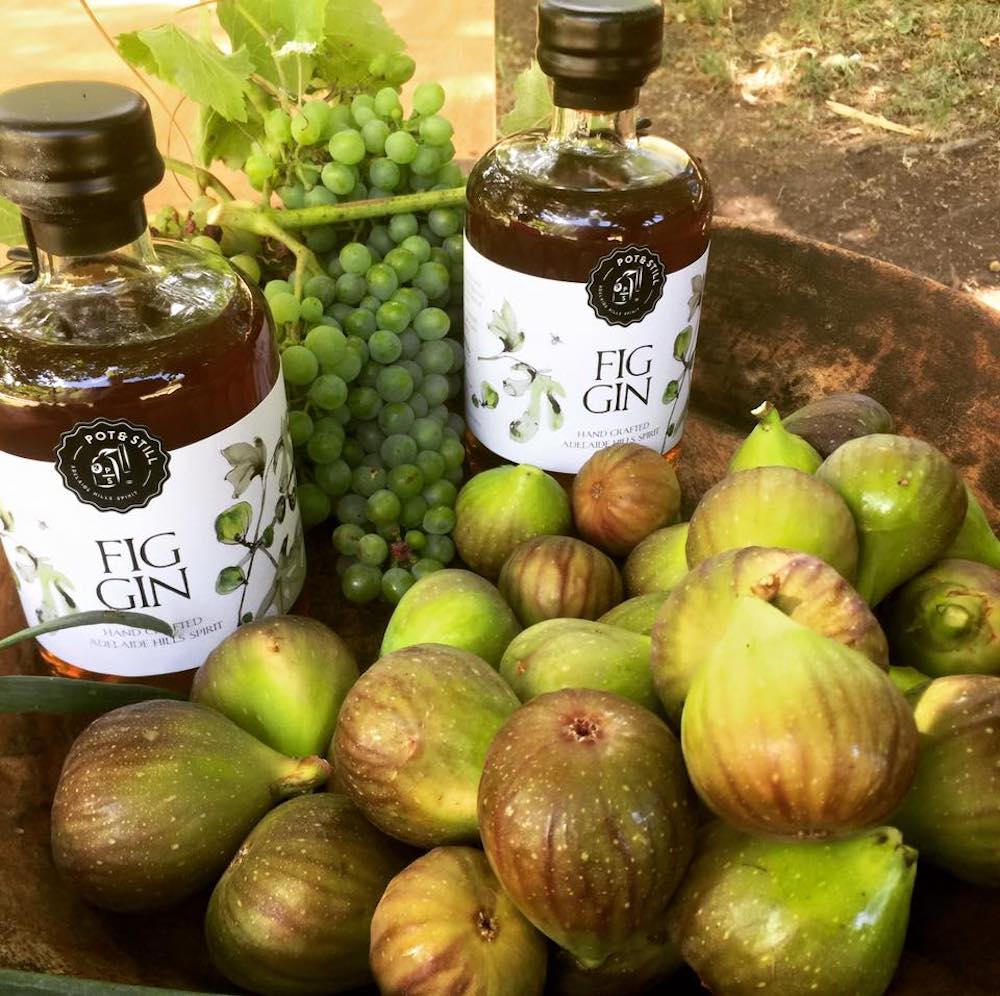
Figs were revered by the ancient Greeks as a staple of life and this year on the annual sojourn to my husband's home in Adelaide I discovered a drink that would have truly been considered a nectar of the gods by those ancient Greeks. Pot & Stills Fig Gin is produced in the Adelaide Hills by a fig grower who was wondering what to do with all their excess figs a few years ago and with the help of a local distiller began turning them into gin. My introduction to the brand came at Cellar Door Fest, a monumental extravaganza for local small wineries who want to make consumers aware of their products. Amidst all the gorgeous wine displays I came across a sight similar to the one below.


The beautiful display of figs and the attractive gin bottles got our attention and after sipping it we left with a bottle of the stuff. I'm not always a gin lover but this drink is fantastic mixed with tonic and excellent just to sip straight with ice and a lime, but don't try bothering to find it unless you're in Australia. Production isn't that large and it has become so popular you have to practically be there when it's being unloaded from the truck to put on the store shelves.

All of this interest in figs got me to thinking about figs in perfumery, for as those of you that love perfumes know, it is always about the scent! Fig is one of the favorite notes I love to wear in summer. It is totally unisex. Almost any fig perfume I can name suits men and women equally well. It is refreshing on its on, but depending what notes the perfumer chooses to surround the fig it can be green, beachy, or jammy, and in my opinion they all have their own appeal. The recent history of fig perfume all started with one woman, though, Olivia Giacobetti who created Premier Figuier for the at-the-time newish brand L'Artisan Parfumeur in 1994. Premier Figuier is said to be the first fig perfume. Two years later Giacobetti would make a fig scent for Diptyque called Philosykos. I own both and only when testing side by side for this post realized that having both is probably redundant.

Perfumer Olivia Giacobetti.

L'Artisan Primier Figuer EDT is like a love letter to figs. Green and succulent, fresh and realistic as if one's hands are covered in figgy pulp. I can smell the purple bruise-colored skin of the fig, the green leaves of the tree, and the way the delicate branch holding the weight of the fig gives a "snap" and you get a hint of the goodness inside the fruit, escaping through the tiny hole left by breaking the connection to Mother Tree. Let me add here that I tried Premier Figuier Extreme and did not get this opening. I didn't find it very interesting so the review is only for the original version. A light milky scent tinged only slightly by coconut creeps in and everything in the scent comes down a notch, not an uncommon occurrence with L'Artisan scents, which are not known for their longevity. Long before its base note of sandalwood appears the scent is just a slight imprint on my skin. I guess this is why the Extreme version was made, but it does not feel like the same scent on my skin. I give this one a 10/10 for the realistic and natural scent but a 3/10 for longevity. But by perfume standards today it's not too expensive so my solution is to carry a decant with me and periodically respray throughout the day, giving myself a small thrill of pleasure each time that I do. I will add that like several of the L'Artisan fragrances, I think it is long gone and then it pops up again, out of the blue.


When I spray Diptyque Philosykos on its own I really enjoy the opening and it feels like fresh fig, but when I do the side-by-side comparison to the L'Artisan it pales for me. It's opening is at first green, but it made me think swampy green. The fig comes in next and it is pulpy and more green than sweet. The milky essence becomes very noticeable. As the scent develops I sense a wetness as if the rain is sitting on the broad fig leaves in droplets and also that smell of wet earth. The scent becomes slightly fruitier and the coconut is there, although not super strong. This one outlasts the L'Artisan EDT on my skin and it becomes a clean yet sensual skin scent eventually. Yet if I had to pick a favorite it is the L'Artisan. The first try was the charm, Olivia.

When I reviewed the Imaginary Authors scents back in 2016, Yesterday's Haze was one of my favorites and you can read the review here. In my original review I wrote about the warmth of the tonka and the delicious figgy vanilla cream. This time, though, I smell just a hint of smoke and woods, like a campfire smoldering near a fig orchard. The smoke smells very organic and it mingles with the slight sweetness of the fig. The Imaginary Authors website lists playful notes of walnut bitters and orchard dust, so perhaps it is the "hazy" notes which create this sense of smoke or dust for me. The greenness of the fig--the twigs, leaves and branches-- are emphasized over the sweetness of the fig in this scent. I am finding this less gourmand than I did three years ago. Can aging skin account for these changes? In any case, I liked it in 2016 and I like it in 2019.


Lothair by Penhaligon's London is a part of the Trade Routes perfume series and is meant to "evoke the tea clipper ships that navigated the globe to bring exotic treasures to Britain's shores." Opening notes are cardamom, grapefruit, juniper, and fig leaf, with heart notes of fig milk, lavender, magnolia, and black tea. Notes of wood, vanilla, and musk round out the base so it is obviously not a fig dominant scent, however the fig note is significant enough to include Lothair in this review. Lothair's opening is dry and spicy and one can picture sailors hauling big wooden trunks on board, fragrant with the scent of cardamom and other spices. Their is the salty tang of sea air and I can almost hear the waves beating against the boat's wooden hull. A whiff of black tea leaves comes from the bulging burlap bags. The fig leaf and fig milk add a slightly gourmand touch to the scent. English tea with cream anyone? This scent has a story to tell and it takes it's time unfolding. Towards the end of the scent life I get a mixture of spice and nuts that is addictive to me, almost like a warm grain cereal seasoned with spice and warm milk and sugar. This scent has a masculine vibe but I love to wear it for it's yum factor. Bertrand Duchaufour is the perfumer.

Detail of lotus painting from Jaipur City Palace, India.

Duchaufour is also responsible for the next perfume I want to discuss, Neela Vermeire Ashoka. The journey of Ashoka is meant to reflect the evolution of the Indian emperor from a ruthless conqueror to a benevolent ruler after his conversion to the Buddha's peaceful teachings. The scent starts with a fierce opening and softens into a floral heart. My own reflections when I spray this scent are Holy Fig! It's that beautiful to me and it is interesting that my mind went there, as Ashoka was a man transformed by his religion.

First are watery notes of lotus, hyacinth and fig leaf which make me think of the lotus dappled water surrounding the floating palace in Udaipur (or they were thirty years ago when I was there on my one year wedding anniversary). There is a thread of scent in this opening that takes me immediately back to the scents of India, garnered from the four years I lived there. I can't describe it to you but my brain recognizes the smell immediately and all I can say is that Duchaufour did his homework. Then creamy sandalwood mixes with milky fig for a swoony comforting and slightly sweet gourmand. In addition to the sandalwood there is a slender trail of incense rising. This is not strong; picture walking past a single burning incense stick with a faint but lingering smell. My perception of this note could be coming from any of these notes: fir balsam, myrrh, ambre gris, birch, Haitian vetiver, or styrax. Ashoka is absolutely gorgeous for the first hour but unfortunately after that the scent weakens considerably on my skin. If I could maintain that beautiful creamy opening of the fig mixed with the sandalwood/temple vibe I would be bathing in this stuff.

L'Artisan Caligna  was made to represent the clary sage fields surrounding Grasse and is an aromatic perfume. In the L'Artisan copy they speak of a jasmine marmalade note which had me super excited when I read it, but which I unfortunately never experience. The scent opens with a note of young fresh green fig. I smell the branches and leaves of the fig tree and the scent that pops into the air in that moment a fruit is plucked from the branches. This is a little more herbal than some of the fig scents I tried. It is innocent and light, and in my case, too light. It just doesn't have the appeal for me of it's sister scent, Premier Figuier, but if you aren't sure about wearing the fig note in perfume this could be a good introduction to the category.

The view from Villa Kerylos, Beaulieu-sur-Mer, France, Cote-de-Azur.

Jardins de Kerylos by Parfumerie Generale references a villa built in the Greek style that sits on the tip of the Beaulieu-sur-Mer peninsula, surely some of the most hallowed real estate in the world. Pierre Guillaume of Perfumerie Generale is French, and although I see fig in perfume as a more earthy and rustic note, this perfume has just a touch of that French fairy dust that makes you think "perfume" and not "fig jam".  The perfume opens brightly, a shaft of sunlight through the dense leaves of the fig tree.The fig note is a bit more muddled but does provide the customary earthiness and fresh fruit gourmand goodness. If you want your fig perfume to be a touch more sophisticated, Jardins de Kerylos could be one to try. A note of sycamore helps keep it dry and woody, and the perfume accentuates the green and woody aspects of fig. Guillaume describes this as luminous and it is so. Fig can be an earthy note but in this perfume it floats. Also to note, I can smell an impression of water, perhaps from this view of the villa.

Heeley Figuier opens with green fig and a touch of coconut. There is a touch of that aquatic note that makes some people smell pickle juice, but I only get the occasional whiff of that and it's not off-putting. The big opening fades quickly on my skin and then the aquatic/pickle smell is more noticeable. If you are sensitive to that note you may not appreciate this perfume. I think it might be discontinued as I am not finding a readily available link to buy.

www.BegonaMorton.com

Au Pays de la Fleur d'Oranger Figue Fruitee is the first scent that I've tried from the Au Pays line (I refuse to type the long name again) that I didn't fall for. It's not that I dislike it but it leaves me underwhelmed. Everything is very muted. The fig isn't really green and is not that fruity. It is a well mannered scent but rather forgettable. I would describe it as fig perfume at 50%. A leather note makes it dry as old boots.

Lubin Figaro is inspired by the Figaro trilogy of comedy plays written by Beaumarchais in 1778 (not a particularly funny time in France, the French Revolution would follow the next year). Figaro's opening is slightly alcoholic to me, but then a note of vetiver enters, grassy, dry and hay-like. This is a masculine scent and although there is a note of fig hiding amongst the vetiver, it certainly isn't prominent. This scent smells like a ride in a horse-drawn cart down a rustic country lane one hundred years ago, the fields lined with hay and in the distance there is a small fig orchard. This scent is dry and dusty.

DSH Perfumes Figue Interdite is a part of the Les Fruits Defendus, vol. 1 line that Dawn Spencer Hurwitz introduced last summer as light weight colognes for hot summer weather. This perfume is 100%  botanical and you can sense this when you smell, or maybe it's what you don't smell...any trace of chemical or synthetic scent. The scent is fresh and pure and totally natural. It is somewhat green, somewhat juicy, but not overloaded with either, just as you would find a fig tree in nature. At the beginning I smell flashes of an herbal, tobacco-like scent. It's very faint and maybe it is the ambrette seed or the vetiver that I am smelling. Although on the surface it would seem to be a simple perfume, like most of Dawn's creations it has a host of ingredients: balsam fir, costus, orris concrete, Mysore sandalwood, Texas cedarwood, jasmine, linden blossom, mimosa....the list goes on and on but you get the idea. Somehow she magically puts these diverse ingredients together and comes up with...fig, and a beautiful fig it is. Like most botanicals on  my skin, longevity is not astounding but that's the trade off. It is a watercolor wash of fresh fig with a beautiful woody skin scent dry down. Love!

www.ful-filled.com

Profumum Roma Ichnusa is green, green, green and in my world, this is a good thing. It's subtle, not a big sillage blaster. It is the green of the fig leaf, the actual fruit of the fig is downplayed here, and the green is like forging through a dense tropical jungle of green leaves. There is a touch of fragrant earth and the fresh aspect of the fig plant. Looking at the listed notes: myrtle, grass, hay, fig leak and fig tree wood, it is no surprise that the perfume feels green. I read that it is a salute to the coastline of Sardinia.

Carthusia Io has been around since 2000 and the perfumer is Laura Bosetti Tonatto. It starts off with a slightly bitter herbal note, not an unpleasant bitter smell but it is bone dry. Beneath this there is a note that reminds me of ocean water with only the slightest tang of salty air. Eucalyptus and mint in the top notes are refreshing and cooling. Anise adds a touch of spice, balanced by calm notes of tea and mint. This feels fresh and bracing, and like one of those scents that would cool you off on a hot day. The fig is dry and green. Very likable.

Don't let me forget Hermes Un Jardin en Mediterranee. This iconic scent by Jean Claude Ellena seems like it's been around forever (it was 2003) but because you see it everywhere I think it can be underrated. This is my favorite of all the Jardin series by Hermes. Jean Claude Ellena said about it, "An expression in perfume of a Mediterranean memory, a mosaic of olfactory, visual, and tactile sensations." From its watercolor wash of citrus note openings to the wood notes of cypress and cedar, it is the fig leaf that has the most distinctive presence. The notes sound simple but this is Jean Claude Ellena we're talking about, one of The Masters, and it is perfection. For some reason I had never taken this on beach vacations but this year I took it to Australia and wore it for my walks along the beach. Mama, Mia! I smell the salt of the water as if the crystals are drying on my skin and in my hair! I only get that salty aspect with the addition of some good old ocean breeze.

Now for something a little more gourmand, Les Senteurs Gourmandes Figue Sauvage  by Laurence Dumont, France. This is a flowery fruity fig with gourmand aspects. If you like fruity florals this is safe territory and you will recognize the dark sweet fruits mixed with ylang ylang and other floral notes as similar to that deep sweet richness found in other perfumes of this type.

Two fresh and light fig scents that I've written about before are Roger & Gallet Fleur De Figuier and Feuille De Figuier. I bought these when I was in France last year and they are pretty inexpensive but refreshing and lovely scents that I've enjoyed wearing. Fleur De Figuier is slightly sweet and Feuille De Figuier is the more green fig leaf. Both are fun, "don't think about it, just spray", type scents. You can read a detailed review here.

Here's one you can treasure hunt for, Miller Harris Figue Amere. It is discontinued but it used to be readily available at places like Fragrancenet.com. I see that is it not, now, but it is still on Amazon. This is a different fig scent; for one thing there appears to be no fig in the ingredients. It manages to juggle fresh and realistic nature smells but at the same time have an Oriental perfume formality. Notes include angelica, balsam fir, violet leaf, narcissus, rose, amber; no mention of even a fig leaf, though. It is like a Picasso, the painting is a woman who doesn't look quite like the woman but you get the idea. Same here. It is not exactly fig but it captures the green bitterness of the leaves and twigs and there is a fruity sweetness underneath it all that resembles fig. More than the other scents I've listed here, this is a fig in high heels and a black dress, or for a man, in a tux and tie. This is one of the few scents in my life that I finished the whole bottle. Why I didn't buy another when it was so available....well, we all have those stories.


Let's look at some really green figs by Rouge Bunny Rouge. They do a couple of interesting scents using fig leaf. Let's first look at Lilt, an unusual scent of green fig leaves mixed with peach. Violet, which to me feels more like violet leaf, softens and sweetens. Later in the scent vetiver and musk make it slightly smokey and moodier. The scent is meant to represent sunlight and shade in a garden which has been pelted with rain. There is a light transparency at the beginning of the fragrance which later morphs into a darker calm. It feels like peach fuzz amidst a green tangle of foliage.

Incantation also uses fig leaf but its opening notes give a totally different experience. Rather than soft sweetness, it is very green and fresh. In fact it is so green that the random thought popped into my head that this is the perfect scent to wear on St. Patrick's Day! It achieves this with top notes of citrus accord, blackcurrant, fig leaf, and green tea. The blackcurrant is pretty tame here, more green than juicy berry. A hint of the spice notes of cardamom and coriander pop in an rose and orange blossom add a tiny bit of floral softness. I still smell the green aspects more than anything. Base notes of vetiver, cedarwood, beeswax, and musk round out the scent. Of the two scents I prefer the green vibrancy and fun of Incantation over Lilt, which starts out great on my skin but ends up a bit muddled and indistinct. Incantation feels darker and a little more mysterious.

 Giovanni Stanchi 1645

You may wonder if any of the perfumes I tried actually reminded me of my beloved Fig Gin? The closest would be Byredo Pulp. On the Byredo website it is described as "a shapeless mass of ripe fruits; unruly and sweet juices that channel flavor bombing". Yep, it's all that. Pulp opens with a stringent note that I took for grapefruit but must be the bergamot. I don't think the opening of a perfume has ever given me such surprise since I smelled Bat by Zoologist Perfumes. Pulp is such a great name because it does smell like the fleshy part of the fruit has been ripped from the rind, maybe a couple of days ago and is in that stage between succulent juiciness and rot. Akin to how jasmine can dance a fine line of being breathtakingly delicate or a fecal shock, this fruit teeters on the edge of succulence and malodorous mess. But it constantly makes me bring my wrist to my nose for another sniff, just like when I'm wearing Bat. Although the fruit here comes across to me as more plum than fig, fig is one of the elements in the melange we have here.

Find recipe at www.The-broken-bread.com

How could I finish a post on fig scents without mentioning Mugler Womanity? I wrote a whole post about it here in great and glorious detail. When I mentioned that the crunchy density of the fig in Womanity reminded me of the figgy pudding we used to eat in Scotland, some readers commented that they wear Womanity in summer as a beach scent for the caviar salty aspect of the scent. I can see that, and now it has become a year round scent for me. It's a mind bender; some love it, others hate it, but it definitely goes where no fig perfume has gone before.

What are your favorite fig perfumes. Have I missed them here? If so, please let me know.


Top photo from www.deviantart.com. All samples my own.

Saturday, May 4, 2019

L'Artisan Parfumeur's Bana Banana


If you're like me the thought of smelling like a banana isn't instantly appealing, thus I almost walked by the L'Artisan display in Saks Fifth Avenue without spraying the brand's newest scent, Bana Banana. I'm so glad I changed my mind because I discovered smelling like a banana can be fun, but I especially love amber scents and that is where this fragrance eventually settles. I can honestly say I did not see that coming; it was an unexpected conclusion to the scent journey.

According to the historical information on the L'Artisan Parfumeur website, the scent of a banana was indirectly responsible for the creation of the company. John LaPorte, chemist and plant collector,  was challenged by a friend to create a banana scent as an accompaniment to the banana costume he was wearing to a gala event, the Folies Bergeres. Laporte accepted the challenge and realized that he had a passion for creating scent and thus the L'Artisan story began. Now decades later this origins story of the brand is being recognized with a banana-scented fragrance, created by Parfumer Celine Ellena.

When I first sprayed Bana Banana as I stood at the L'Artisan counter I almost laughed, the banana note is so realistic and dare I say, joyful. It smells a little like banana ice cream...think creamy, not sweet. It is also slightly green, emphasizing a tropical feel. This is not an over-ripe sugary banana. It is as fresh as if just picked. The banana note continues unabated for some time but is joined by floral notes of jasmine and iris and at this point the banana note becomes less prominent. Jasmine and iris are both fairly identifiable notes but here they blend to project a floral loveliness around the banana note; a beautiful melange without strong distinction for the individual florals. This may sound like floral plus fruity perfume but that is not how the smell translates; the scent is more subtle and polished than this. There is a mild spiciness of pepper and nutmeg; the pepper is weak, the nutmeg more forward. These spicy notes add interest, making the scent feel slightly gourmand. The scent continues to waft this soft floral banana note, accented with nutmeg and pepper, for a full two hours. Then comes Act II. Enter musk, tonka, and amber to the stage.

Bana Banana has slowly been transitioning to more of a skin scent with warm and slightly spicy overtones. The tonka and musk make the scent comforting and warm with a slight muted fuzziness. But then I start recognizing the amber in the scent. My skin loves amber and maybe because of that it is one of my favorite notes, but it has such depth and strength that I tend to only wear amber perfumes in cooler weather. Here we have a lighter amber, something I don't replicate in my collection of amber perfumes. As a comparison, I like light beer because it has the taste of the beer without all the heaviness that makes me feel full after four sips of regular beer. It feels the same here. You get all the beauty of the amber scent but it is somehow lighter, loftier. It radiates warmth and comfort as amber does, but doesn't overpower. If I think about it I can still smell the slightest trace of the banana in the scent.

The final stages of the perfume brought this image to mind. Just go with me here; this is a slightly strange analogy. The best baking tip my mother ever gave me was to slightly undercook cookies and sweet breads. If you stick a toothpick in a loaf of banana bread to test for doneness and it comes out totally dry then it's already too late. But if you catch that loaf of banana bread just before it gets cooked throughout and the toothpick comes out gummy there will be a moist almost doughy center. The next day instead of the bread being too dry to eat that moist center has become richer and more redolent of the banana flavor and the spices have intensified. That is how the dry down of Bana Banana feels to me; we've smelled the freshness of the banana but now it has transitioned into a richer state; slightly sweet gourmand, spicy with the zest of nutmeg, a mellow banana, a slice of blissful comfort.

If you are curious how a banana note smells in a perfume give Bana Banana a try. You may be pleasantly surprised like me. And if you like amber perfumes definitely try Bana Banana as this is very different from any other amber perfume you might have in your collection.

Top photo from L'Artisan. Thank you Saks Fifth Avenue Houston for the spray.

Saturday, August 25, 2018

Travels In France, Part Three: Grasse, The Birthplace of Perfumery


I had a romantic view of my visit to Grasse. If Paris is the home to great perfumeries than Grasse is its heart. But various people gave discouraging views. "It's so industrial," said a friend who has a home not far away in the picture perfect town of Valbonne, which if these medieval villages went by hotel star rating systems would definitely be a five star. A hotelier who asked where we were going next wrinkled his nose and said, "You should have been ten years ago. Or twenty. Grasse has changed." Undeterred, myself and my patiently accommodating husband headed east toward Grasse. When we were about two kilometers from the city I bolted upright in my car seat, frantically rolling down the window, my nose quivering like my dog's when she smells a squirrel on her walk.

The air was full of scent of some unknown flower. We were driving into a cloud of scent. We were driving toward a SCENTED CITY! I was beside myself. In my imagination this was due to field after field of flowers, though unseen, out there somewhere. Later when I would find out that this is the scent the perfume factories emit when in production I was only slightly disappointed. It sure beats the smell of hops that used to emit from the Miller Brewery that I had the misfortune to live beside long ago in my very first apartment when I was twenty-one.

Our hotel  was a couple of kilometers outside the city and offered beautiful views of the surrounding countryside from the patio, and it was a great place to relax with a wine after a long day of touring.

Hotel La Bellaudiere, Grasse, France

The next morning we were almost the first ones in the parking garage at the Grasse tourist center, as no cars are allowed in the old part of the town and in fact would be unable to maneuver down the narrow lanes. As I set foot on the town square, which has small brass plaques with the Grasse emblem I felt a thrill. This was a big tick off my bucket list!


We found a coffee shop on the town square and as nothing was yet open we perused our options.


Most perfume shops don't open until eleven so the first stop would be the Musee International de la Parfumerie. I expected to spend a quick hour there, but it turned into an almost three hour visit. The exhibits were much more interesting than I had assumed, especially the first floor which highlights the early origins of perfumery, starting with the Greeks and the Egyptians.

Musee International de la Parfumerie de Grasse, www.museedegrasse.com

Museum exhibits traced the journey of perfumes from the earliest known origins to present day. Even my husband, who does not share my fascination with perfume, found much of interest. There was an exhibit on the origins of the perfume industry in Grasse and I learned that originally fragrance was used to scent the leather for gloves, as Grasse was the center for providing quality leather to the ancient glove making industry. It was in the twelfth century Grasse first became known for its tanneries but an unpleasant side effect was the strong and unpleasant stench which was a byproduct  associated with the tanning of leather. Grasse traded with its nearby neighbor, Italy, and over time the leather became popular to produce gloves. The wealthy and royal families who could afford fine gloves did not like the bad scent so eventually the practice of perfuming the leather came into being. The popularity of this practice was ensured when the family Galimard, Grasse tanners, presented Catherine de Medici in Italy with a pair of perfumed gloves. She came to France to marry Henry, Duke of Orleans, who would eventually become King of France, and her influence helped spread the popularity of scented gloves. Even Queen Elizabeth in England adopted wearing the gloves. Below is painting where she is clutching her gloves which were a prized possession.

Google image.

L'Artisan Parfumeur Bucoliques De Provence was introduced in 2016 as the first in a new series of perfumes highlighting various distinct regions of France, and fittingly Grasse, the spiritual home of French fragrance, was first. Bucoliques De Provence was not the lavender and citrus combine I had imagined it would be before trying. The perfume features lavender, iris, and leather and is meant to refer to the leather industry that preceded perfumery, and in fact brought the fragrance industry to Grasse. The lavender opens the perfume but it is not sharp antiseptic lavender but herbal and fresh; in fact it took me a moment to realize I was smelling lavender as it is so softened. It feels a bit earthy as the iris root begins to enter and I love the iris and lavender combination. The leather note comes in and changes the scent to a soft suede skin scent. Most L'Artisan scents are fairly muted on my skin and this one is no exception; however it is a soothing and beautiful scent. It reminds me a little of Penhaligon's Iris Prima with its iris and leather combo but the lavender gives Bucolique De Provence a pleasant depth. This would equally suit men or women. I like that L'Artisan did something a bit unexpected for a perfume with the name Provence in it, referencing leather rather than a sunny lavender field or fields of rose and jasmine. As the perfume develops the lavender fades on my skin and it becomes a floral, musky leather. If leather is an uncomfortable note for you this would be a good one to try; the leather note is light and well done. One other thing to note: in my travels when talking with other perfumers, L'Artisan is the one brand that got mentioned as a perfumer I should check out and that they appreciated. I found that interesting.


Walking the twisted cobbled streets of Grasse led to fragrant shops and quaint restaurants. I was surprised how few name brand perfumeries have a presence in Grasse, and the big name brands are completely absent. The majority of the shops were more tourist oriented with distilled lavender or homemade soaps. It does seem that there is the beginning of a movement in Grasse to bring back more niche perfumeries.


My next post will be about perfumes by Olivier Durbano, as I was lucky enough to meet and have an interview with him while in Grasse. However there was a perfume shop which I kept missing the opening times, and now that I'm back home I feel like an idiot for not making it happen. This was  Micallef Perfumes which has a storefront on the main square in Grasse.


M. Micallef  was launched in Grasse in 1996 by co-founders Martine Micallef and Geoffrey Nejman. From humble beginnings, the brand can now be found in over 900 location points. M. Micallef is known for having some beautiful and luxurious bottles, an offering which perhaps coincides with their entry into the Middle Eastern market. Despite their burgeoning popularity and points of sale, the brand has remained true to its beginnings in Grasse and its door is just off the main square. They have numerous offerings but as roses is a flower crop for which Grass is renowned and I happen to quite like one of the brand's rose perfumes, I chose it to review.

The Roses of Heliogabalus, painted by Sir Lawrence Alma-Tadema in 1888.

This is a painting I saw in the International Perfume Museum de Grasse. I assume I must have seen a replica as Wikipedia says it is owned by a Spanish billionaire. It is reported that artist Alma-Tadema had rose petals sent each week from the south of France for the four months he spent painting this commissioned work. The painting illustrates a (probably fictional) incident in the life of Roman emperor Elagabalus, when he supposedly released a torrent of petals from a false ceiling onto his dinner guests, smothering some who were unable to crawl from beneath the mass of flower petals. It seems unlikely but it's a good story.

I post this picture because this is how M. Micallef Rose Extreme strikes me on first spray. It as if diving head first into a cart of rose petals and being overcome by the opulence of the smell. The rose is accompanied by osmanthus which here smells like a honeyed apricot and is a beautiful partner to the note of peach. These notes, along with what smells like a luscious and high quality rose oil make this a juicy, almost boozy, fragrant treat. It reminds me a little of the rose ice cream I had a couple of times in Provence. The ice cream was yummy and so is this fragrance.


Fragonard Parfumeur has a huge presence in France and particularly in Grasse. They have a simpler and smaller museum related to perfume and one can also tour the factory to see how perfume is produced.

Photo of Fragonard Parumerie in Grasse, www.lemeilleurestavenir-leblog.com

For the most part Fragonard seems to make lighter perfumes, often featuring a single note, that are fresh and easy to wear. The bottles often have appealing and vivid artwork and in their shop they had many cute gift bags that would appeal to the casual tourist who doesn't have a huge interest in perfume but wants a perfumed gift. Every year Fragonard features a note and for 2018 that note is Verveine.


Just down the street from the Fragonard shop is the Musee Fragonard, featuring artwork by Jean-Honore Fragonard, 1732-1806. Jean-Honore's father was a glove maker but he was sent to an art academy when his talent became apparent at a young age. Fragonard would go on to paint in the Rococo style, featuring scenes of fabulously dressed subjects partaking in various manner of flirtation. The French revolution put an end to the popularity of this style of frivolity and it would only be many years after his death that his paintings were once again appreciated. Below is a portrait that hangs in the museum.

Jeune fille deliverant un oiseuau du sa cage, Jean-Honore Fragonard, 1770-1772

If you are visiting Grasse you can also tour museums at Molinard and Gallimard, but unfortunately my time in Grasse ran out before I was able to visit.

I couldn't end a post about Grasse without mentioning a perfume I have worn for years, DSH Perfumes Parfum de Grasse; in fact, it was one of my earliest acquisitions from the talented Dawn Spencer Hurwitz's line. Dawn is an American perfumer, not French, but like many before her she was inspired when she visited the city which is the birthplace of perfumes. Dawn says that her visit to the south of France also happened to be on her honeymoon!

"We visited Grasse in May, during the rose festival, and were lucky enough to get a behind-the-scenes tour of Grasse, which included a trip to the fields of roses and jasmine grown exclusively for Chanel," said Dawn. "The orange blossom trees were in bloom, as were the mimosa and cassia trees. It was the most magical day and that is what I wished to portray in Parfum De Grasse."

Dawn says on her website that Parfums de Grasse is, "A Hymn. A homage to the City of Perfumes." I love when Dawn does vintage and this perfume definitely has that vintage feel of fine French perfume. The opening it a dazzling shaft of light presented in the form of bergamot that smells as if it has been distilled into a rich golden chardonnay wine. The very French note of mimosa flower is in the opening as well, along with neroli. I find the mimosa faint, just adding a honeyed sweetness. Floral notes of carnation, rose, iris, and jasmine slowly creep in, but it is the rose and carnation which will have the biggest presence, at least to my nose. The structure is enveloped in a French beeswax which smells so true to life, with that musky sweetness and honeyed effect. Base notes of Brazilian vetiver, sandalwood, and oakmoss round off the classic feel of this fragrance. The notes in Parfum de Grasse give a nod to typical French-style notes: rose, jasmine, and mimosa. The bergamot opening and the oakmoss finish give the perfume a chypre structure, minus the labdanum. This is a perfume I put on to feel polished to perfection and a little dressy. It's more subtle on me than the notes might sound, but deeply beautiful. This perfume is 98 percent botanical.

A final thought, how cool is this? Walking down a lane towards the Fragonard museum this perfumed mist was dispersing a veil of scent from above.

www.TheSageLifestyle.com

Please read more about perfumed travels in France at Part One or Part Two.

All perfumes my own. All photos my own unless otherwise labeled.

Sunday, January 21, 2018

The Best Carnation Scents To Wear In Cold Weather


When winter comes I typically put away all my floral perfumes which tend to be concentrated in the white flower category. I take advantage of being able to wear chypres and heavy oriental fragrances which just don't work so well in one-hundred-degree weather. It was very cold here in North Texas over Christmas and I noticed my daughter in law smelling wonderfully of carnation. I keep a little bottle of Dianthus by Etro on a toiletry tray in the guest bath. I hate the furnace belting out heat so my house is always, shall we say, a bit chilly. The brightness of the carnation bloomed beautifully against the chill air, almost giving the florist freezer effect of carnation flower arrangements. I decided to test all my carnation fragrances and see if they all stood up as well to the cold weather.

Christian legend says that the carnation originated when Mary was moved to tears as she saw Jesus carrying the cross, and where her tears fell, red carnations sprang from the earth. Leonardo da Vinci painted a portrait in 1480 called The Madonna of the Carnation, in which the infant Jesus reaches for a carnation in his mother's hand, foretelling the event of the crucifixion.  


In Victorian times carnations could relay unspoken messages to an admirer. Red meant yes!, a white and red striped carnation meant I can't be with you, and yellow sent the sad message of no! 

Carnation is often thought of as old fashioned, maybe because of its powdery notes, but I've always loved it. Even in flower arrangements it has the reputation of being a cheap filler flower. Today my local grocery offers a large and varied selection of flowers for bouquets but twenty five years ago the choice was either roses or carnations. Often the carnations had been dyed ghastly colors and eventually the beautiful smell was bred out of them, I suppose in the interest of hardiness.

Dianthus Etro is what my memory is of the perfect carnation scent from when I was a little girl. There was a time that if you bought a little bouquet of carnations they would scent your whole house with their fresh presence and I have found that some floral distributors have returned to breeding scented carnations, realizing that scent is the flowers greatest gift. Dianthus is fairly one dimensional but it smells like the freshest, prettiest carnation ever. It does have a slightly powdery element but that is not its strongest quality. If you want realistic carnation you can't do much better than this. Disclaimer on this review and several others here; my bottles have been around for over five years so I don't know if any changes in formulations have taken place.


L'Artisan Oeillet Sauvage is another light take on the carnation scent and although I own a bottle, I find that I prefer the Etro for its spicy realistic notes. There is just a moment of alcohol scent in the initial spray but it disappears quickly. The carnation is softer and a little peppery, without that full-on rush of refreshing, nose clearing carnation scent. Notes of lily and ylang ylang provide a sweetness and temper the spiciness that can be found in carnation. The perfumer is Anne Flipo who has created several scents for L'Artisan. The initial release was, I believe, a limited edition and it got rave reviews. It was reissued and that is the series I have. Some people said the formulation had changed but others thought it was the same. I don't have an opinion as I didn't try the initial release. It is readily available at perfume discounters.

Prada Infusion d'Oeillet is another more transparent take on the carnation, although for the Prada Infusion line, it is one of the heavier hitters. The pale pink juice in the handsome Prada bottles is pretty alluring and if you like carnation you will definitely like this scent. I reviewed it fully here.


Miller Harris Fleur Oriental was released in 2000 and it uses carnation as the heart note for the oriental scent, cushioning it in a bed of vanilla and amber for a creamy base. The powdery note of carnation is further enhanced by a healthy dose of heliotrope. This is a softly romantic scent and a very pretty take on using carnation as a main note, but not a soliflore.

Dawn Spencer Hurwitz of DSH Perfumes is always curiously exploring new areas of scent and when something captures her interest she goes all in, exploring it from various aspects. Right now the scent of fur has captured her imagination but when I first became aware of Dawn's work about ten years ago she had been exploring different takes on carnation fragrances. Some are not in production anymore but she picked the best to survive, Oeillets Rouges (red carnations). This is the rich deep scent of carnation with a touch of clove, and a light touch of honey and ambergris give it a deep and lasting edge. This one is particularly unisex. Fleuriste was launched in 2015 and in a review here I said the following, "Fleuriste brings back that lovely memory of opening the refrigerated door and being engulfed in that exquisite smell of fresh carnations." Although either could be worn at any time I would say that Oeillets Rouges is for night wear and the freshness of Fleuriste lends itself to daytime wear. Lastly, DSH's Souvenir de Malmaison combines carnation with rose, spice and amber for a luxurious floriental. Dawn's appreciation for the carnation is evident in her scented creations and one of these three is sure to fulfill your search for a carnation scent. 

Maitre Parfumeur et Gantier Soie Rouge is listed as a fruity floral carnation. Again, I am going by an older sample so maybe the notes of pineapple, dried fruits, and apricot have lost their power. What I get is the standard carnation opening with the powdery notes of heliotrope emphasizing that aspect of carnation. This was one of the more powdery scents I tried so depending on your like or dislike for powdery scents, consider yourself warned. 

Fujit Amor by Jul Et Mad Paris is a fairly new creation from 2017 and features a most unusual interpretation of the carnation note, unlike any of the scents above. The inspiration is Rodin's statue Fujit Amor, two straining bodies captured in marble. The carnation is meant to represent the marble's cool touch, but warm and spicy notes of elemi, ginger, pink pepper, and  cinnamon portray the lovers' passion. An unusual combination of carnation and lavender is featured, two notes which on their own can be stingingly sharp and crisp, but here they blend to form a rather sweet and soft mixture which I can still smell on my skin the next day. I won a sample of this perfume after reading a review by Gail Gross on Cafleurebon and the sample was provided by Indigo Perfumery. Thank you to both Cafleurebon and Indigo Perfumery for making this review possible.

Carnation is the birth flower for January babies. There are many choices here, from a perfect scent copy of the flower to an unusual blend featuring the note. Anyone with a fondness for the scent of carnation should find something here to please.


Carnation photos are vintage clip art. Kitten and carnation photo from a painting by Leon Charles Huber.

Wednesday, September 13, 2017

Travels In Spain, Part Five: Granada and the Alhambra


Reviewing: Rania J Cuir Andalou, L'Artisan Histoire d'Oranger, MDCI Nuit Andalouse


A visit to Granada would complete our tour of Spain's Andalusian region. We had stopped at the beach along the way after our departure from Ronda so our arrival was in the late afternoon. Catholic monarchs may have conquered this area in the 1400's but the city's medieval Moorish past is alive and well in the Albaicin, the old part of the city where we were lodging. Our accommodation was atop a steep hill accessed by thread-narrow streets with impossible 90-degree turns amongst claustrophobic walls, navigated in our now obviously too-large car. We gratefully arrived at our destination and after settling into our very comfortable apartment atop the hill we went to get directions to the city below. "Right at the bell tower, left at the carpet shop, past the lantern stall and down the hill," we were told.

The directions sounded a little bit like Peter Pan's directions to Wendy: "Second star to the right and straight on 'til morning." When we arrived at the bottom of the hill we were spilled into a rabbit warren of narrow cobblestone paths lined with stall after stall selling leather goods, colorful glass lanterns, fancy spices, and indeed, it did seem we might have stumbled into Neverland, or at least Morocco.


It truly felt as if we'd left Spain and sailed across the Strait to North Africa. It was admittedly a tourist trap of goods, but the food in the colorfully decorated restaurants was amazing and the place came alive at night.


I had brought a couple of leather-based perfumes with me and decided that Cuir Andalou by Rania J  perfectly reflects the smells and exotic attitude found in these shops of the Albaicin. Cuir Andalou opens with the smell of new leather, such as when you first purchase a quality leather bag. It is nice but fairly linear on my skin for the first thirty minutes and I am starting to be disappointed, as I found Jasmine Kama by Rania J (reviewed here) very interesting. I was expecting more than this. Just about the time I've forgotten about the perfume I suddenly start smelling something wonderful. My chin is resting in my hand and the scent wafting up off my wrist smells divine as the perfume starts to bloom. I'm still smelling the leather but it has been muted with the scent of flowers and a trail of smoke. As time passes I'm smelling the whole ambience of these lanes and the narrow shops filled with exotic goods. I smell the warm spices, the faintest touch of flowers in the iron window boxes overhead, dust, and earth. There is a curious combination of smoke and oud, like warm incense and candles burning against the cold stone of the sanctuary walls. This perfume feels as ancient as the streets I'm walking. Castoreum makes the leather more pronounced and gives it an animalic quality. Patchouli and vetiver give the perfume its earthy appeal. Notes of neroli, rose, iris, and violet are responsible for the floral mid notes and saffron adds spice. The base notes include sandalwood and oud.

If you can't tell from my description, I find this perfume very appealing. I often have trouble with leather notes so when I find one I like it makes me happy! To date my favorite leather perfume has been Bottega Veneta but this one is a contender. My only gripe; its longevity is not what I expected. It throws off such a mesmerizing glow for several hours that I assumed it would be one of those perfumes that I could still faintly smell at night and even into the next morning, but such was not the case. However that is easily solved by spraying again. This is another win for me from Rania J.


This is the Alhambra. It is why people come to Granada. Like a magical palace cast from tales of the Arabian Nights, the Alhambra looms high above the town of Granada, and it is one of the largest and busiest tourist attractions in Spain. In fact since we were going to be in Granada during August, the height of tourist season, we had to book tickets to view the Alhambra a couple of months in advance as if going to a concert. Show up without tickets and you probably won't be able to get inside. You can choose morning or afternoon viewings, and as I had read that most tour groups go in the morning slots I opted for the afternoon. It is a huge complex and it took us several hours to make our way through the grounds, palace, garden, and ruins.

As in Seville, my visit was not timed for the blooming of orange blossoms but since it is such an iconic scent of the region I decided to review two more orange blossom based scents. My fellow blogger, Undina, will probably be happy this is my last orange blossom review as I just found out she doesn't care for the note!

Pinterest image of Generalife Gardens in the Alhambra.

L'Artisan Histoire d'Orangers was introduced in 2017 and perfumer Marie Salamagne asserts that the inspiration for the perfume came in the form of a scented memory from a trip to Morocco. L'Artisan has not had a pure orange blossom scent (correct me if I'm wrong here) since the release of its limited edition scent, Fleur d'Oranger 2007. There was the release of Seville a l'Aube which features the orange blossom note, but it is really too complicated of a scent to call it just an orange blossom perfume. I have a bottle of the limited edition from 2007 and I will be comparing this new orange blossom scent to L'Artisan's older model.

Histoire d'Orangers has a beautiful opening, all gauzy and floaty with tendrils of orange blossom releasing their scent on the warm soft breeze. The orange blossom feels wispy and almost transparent and opening notes of neroli give green aspects of the plant to lend a scintilla of bitterness which balances the flower's sweetness. In contrast to this graceful opening, the 2007 limited edition version begins with the clash of fragrant cymbals as notes of orange blossom make a dramatic entrance to the stage, accentuated with great dripping lashings of honey. Whereas Histoire d'Oranger feels like you're strolling down the path and suddenly catch the scent of some distant orange blossom trees, the 2007 version feels like you've lain in a hay field bordered by a grove of orange blossom trees in full bloom, the scent of nectar is thick in the air, and the sound of bee's buzzing gives a somnambulant, almost tipsy effect.

Garden in the Alhambra. 

The new Histoire d'Oranger begins to quietly build in intensity. The structure of the smell hasn't changed; it's just building steam and gaining more presence. The musk has entered the scent and to me it intensifies the gauziness of the orange blossom, amping down the sweetness to a manageable level and thus intensifying it's fuzzy comfort effect. Ambroxan in the base intensifies this aura, and with a tonka bean note adds  a slight creaminess to the scent. There is supposedly a note of white tea in the perfume but I don't smell it; for that matter, when I drink white tea I don't taste anything, so there's that. Meanwhile, my arm sprayed with the limited edition is smelling more like a jar of orange blossom honey than orange blossom. The beeswax has intensified and it is much heavier and more gourmand than the Histoire d'Oranger. I'm taking into account that my bottle is ten years old and the top notes may have dissipated somewhat. My memory of what it smelled like ten years ago is unclear and my tastes have changed since then anyway.

When comparing the two orange blossom L'Artisans side by side the new Histoire d'Oranger seems a bit pale in comparison to my 2007 version. But when I tested it again on its own I was able to appreciate the art of the way perfumer Ms. Salamagne has delicately rendered the orange blossom, making what can sometimes be an almost obnoxiously dominant white floral into a diaphanous white scent trail. I really enjoyed wearing Histoire d'Oranger and believe it deserves to stand on its own accolades within L'Artisan's stable of scents. However if you are not an appreciator of that flower I doubt this perfume will win you over.


MDCI Nuit Andalouse is the last of the perfumes I'm reviewing that were inspired by the Andulusian region of Spain  and it's a favorite of mine. I think all the MDCI perfumes are well done, but this one! It literally makes me swoon when I first put it on! My eyes roll back, I'm weak at the knees, and all the little happy! happy! receptors in my nose are bursting into the Hallelujah! chorus. Ok, maybe I'm laying it on a bit strong but this smells so good! The blurb on the Parfums MDCI  site describes Perfumer Cecile Zarokian's 2013 olfactory representation of an Andalusian night thusly: "An enchanting composition around the gardenia theme which carries us at the heart of a warm summer Mediterranean night, languid, with the rustling whisper of the fresh fountains and of voices and far-off signings (sic) which can be heard in the splendor of the gardens."

The listed opening notes are orange, violet, and green notes. There is something magical happening in that opening but I would never have been able to pick those notes out, not even the orange. The combination smells ebullient and lilting and serves as a launching pad for the next stage, the entrance of the gardenia, ylang ylang, and rose. These notes have never smelled better together. The creaminess of the ylang ylang, the lushness of the gardenia, and the primness of the rose, all together in one big beautiful bouquet. Later base notes of sandalwood, vanilla, and musk will soften and ground the bouquet. Once I'm about thirty minutes into the wear of this perfume the notes start settling down and my initial excitement abates. Several hours after application I mostly smell creamy vanilla and ylang ylang with a slight hint of the gardenia. At this point in the perfume's life, I've been to this party before; it's nice, I'll stay, but it's not sending me over the edge as it does initially. While it would be nice to live in the perpetual state of bliss that the first spray delivers, it's just not meant to be. Even in nature, beautiful scents are fleeting. If you are continuously exposed to something it loses its magic, at least that's what I believe. Clearly, I love this perfume, but if you don't like bursts of big florals or the creamy sweetness of ylang ylang and vanilla then this may not be your cup of tea.

As for me: have you ever been someplace that is so beautiful that you think I have to remember this. Or had a moment that you think I'll pull this memory out next time I need to be reminded that the world can be beautiful. I have had several of these moments when I travel and a couple on this trip. The opening notes of this perfume is the olfactory equivalent of those moments: something that can't be sustained for too long or it would lose it's specialness, but oh, how beautiful it is while it lasts.

This wisteria is why I need to go back in the spring! Only a few blooms when I was there in August.

And now for Serendipity. The hardest thing in the world for me is to get rid of books. We had to clear out my parent's house eight years ago after my mother passed away, but I still have a couple of boxes of my father's random books that I wasn't able to find space for or rehome. During the time I was in the midst of writing this review I decided it was time to get those boxes off the floor. I went through the boxes and hiding at the bottom underneath the other books I found this.


When we were at the Alhambra there were several references to the writer Washington Irving, his stay there, and the book he eventually wrote called Tales of the Alhambra. I had decided I would seek it out to read once I got back home, so this discovery felt like a gift from my Dad who's been gone thirteen years now, delivered at exactly the right moment!

Read more about Spain, this trip, and my perfumes at Part One, Part Two, Part ThreePart Four, and Part Six.

Top Alhambra shot: www.RayburnTours.com. Second Alhambra shot: from Architecture Arts and City. Wisteria shot from Pinterest. All other shots my own unless noted. Perfumes my own.